


You Don’t Look Depressed
You get up and go to work. You respond to texts. You make dinner, show up to things, perform at a level that satisfies everyone around you. From the outside, there is no story here.
But inside, the volume is turned down. Things that used to feel good feel neutral now. Weekends come and go. You stop looking forward to things without quite noticing you’ve stopped. At some point you started describing yourself as “fine” and meaning it. Not because things were fine, but because the gap between fine and better became hard to imagine.
This is what high-functioning depression looks like. Not dramatic. Not collapse. A slow, sustained dimming that’s easy to miss precisely because you never stopped moving.
You’ve probably been calling it stress. Or burnout. Or just being an adult. You’ve been waiting for it to lift, setting mental benchmarks. After this project. After this season. After things settle. And it doesn’t quite lift. Or it does, briefly, and then it comes back.


What High-Functioning Depression Actually Is
High-functioning depression isn’t a formal clinical diagnosis. It’s a way of describing something real that people experience. Depression that doesn’t look like depression from the outside, because the person experiencing it is still managing to keep up.
Clinically, it often maps onto Persistent Depressive Disorder, a low-grade, chronic depression that can last for years. Unlike a major depressive episode, which tends to be severe and harder to hide, this version is quieter. More like a permanent filter on your experience than a flood.
Some people with high-functioning depression are also navigating a major depressive episode. They’re just very good at masking it. They’ve been doing it so long it feels like personality.
The distinction between those two matters for treatment. But in both cases, the experience has something in common. You’ve been functioning at a fraction of your actual capacity for a long time, and you’ve probably adjusted to that so gradually you’re not sure what full would feel like anymore.
The Signs That Are Easy to Dismiss
High-functioning depression is designed to be overlooked. By other people, yes. But also by you.
The symptoms aren’t dramatic. They’re the kind of things that sound like excuses when you say them out loud.
Low-grade sadness you can’t quite name. Not crying-on-the-floor sadness. More like a heaviness that’s just there. Most days. Underneath everything.
Losing interest in things without noticing. The hobbies you’ve dropped, the plans you stopped making, the things you used to look forward to that you just don’t anymore. It happened gradually. You called it growing up.
Running on willpower. Getting through the day takes more effort than it should. You can do it. You do. But the energy it costs to perform normal is quietly expensive.
Irritability with no obvious cause. Not sadness, exactly. More like everything is slightly too much and your patience for it is thin.
Waiting for your real life to start. The sense that actual enjoyment is always just around the corner, after some threshold is crossed, and it keeps moving.
Flat stretches with no explanation. A weekend that should have been good. A dinner that was fine. A success at work that left you oddly unmoved.
These don’t look like depression because they don’t stop you. That’s the point. High-functioning depression’s defining feature is that it keeps showing up to work.
Why You Haven’t Gotten Help Yet

Most people with high-functioning depression spend a long time not getting help. The reason is usually some version of the same thought. I’m still functioning. I’m not that bad. Other people have real problems.
That argument is very convincing when you’re the one making it. It keeps working for years, sometimes decades, until the functioning itself starts to break down. Or until you get tired enough of the version of your life you’ve been living that the threshold finally shifts.
The cost of high-functioning depression isn’t always visible. It shows up in relationships where you’re present but not really there. In the creative or professional work that used to come naturally and now feels like effort. In the small pleasures that have quietly left. In the low-grade exhaustion of maintaining the appearance of fine.
“Not bad enough” is one of the most effective barriers to treatment there is. And it’s one of the most important things we work through with clients who come in having described themselves that way for years.
How We Approach High-Functioning Depression
The challenge for high-functioning depression is that the usual crisis motivation isn’t there. You’re not at the bottom. You’re somewhere in the middle, which makes change feel less urgent and harder to prioritize. A good therapist helps you build the motivation for change by first making the cost of not changing clearer (this is what it’s actually costing you).
For many people with high-functioning depression, cognitive behavioral therapy is a strong starting point. The thought patterns driving this kind of depression are often deeply embedded. Low-grade negative self-talk, a filter that mutes the positive and amplifies the neutral. CBT works directly on those patterns. For people whose depression is rooted in older relational dynamics or unprocessed experiences, IFS or EMDR tends to get further than working on thoughts alone.
We also pay close attention to what therapy is asking of you. High-functioning depression often coexists with overcommitment and perfectionism. Therapy that adds to your to-do list without building toward something that actually feels different tends not to hold. We try to make sure it does.

What to Expect When You Start High-Functioning Depression Therapy
The first session often starts with some version of the same thing. “I’m not sure I’m bad enough to be here.” That’s the most common way high-functioning depression presents when someone finally reaches out.
The early sessions are about getting specific. There’s usually no crisis to present, and that’s fine. The focus is on what your actual interior experience looks like. What’s been flat. What you’ve stopped expecting to feel. Where the energy goes that should be going somewhere else. Most people haven’t had the chance to articulate any of that clearly, because everything looks fine from the outside and there’s been no occasion to say it out loud.
Once the picture is clear, your therapist works with you to figure out what’s driving it and what’s keeping it in place. For some people that’s a set of thought patterns that have been running on autopilot for years. For others it’s something older underneath. The direction comes from what’s actually there.
The work tends to be steady rather than dramatic. You’re not resolving a crisis. You’re changing the baseline. Most people start noticing something shift within the first couple of months. Small things first. Things that used to feel neutral start having some color. The effort it takes to get through the day quietly decreases. That’s how you know it’s working.
Areas We Serve
Most of our high-functioning depression clients are professionals managing full lives across Philadelphia and the surrounding suburbs. Center City, Rittenhouse Square, Northern Liberties, Fishtown, University City, South Philly, Graduate Hospital, Society Hill, and Queen Village, as well as the Main Line, Montgomery County, and Chester County.
Early morning and evening appointments exist specifically for people who won’t cancel on a client but will cancel on themselves. Therapy shouldn’t have to compete with everything else you’ve committed to.
Online therapy is available throughout Pennsylvania and New Jersey. For this type of depression, remote sessions tend to work well. Not because getting somewhere is too hard, but because having one fewer logistical step makes it harder to talk yourself out of going. A session you can take from your desk at 6pm is a session you’re more likely to actually keep.
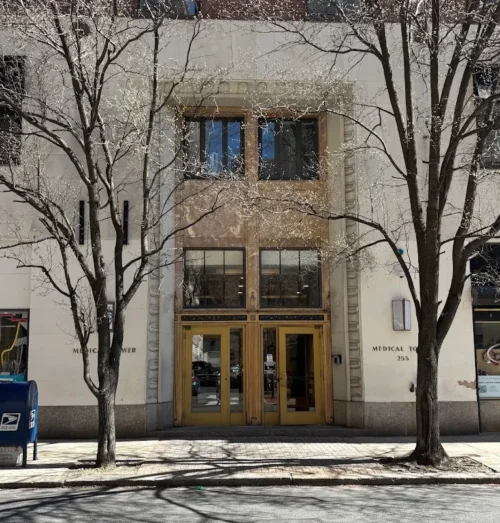
Philadelphia Therapy Office
In the heart of Center City Philadelphia, our office offers you convenient access to expert care. With flexible appointment times to accommodate your busy schedule, we’re committed to making your therapy journey as seamless as possible. Also offering online therapy in PA and NJ.
Offering Online Counseling In
You’ve Been Fine Long Enough
High-functioning depression is real, it’s treatable, and it responds well to therapy. The fact that you’ve been managing doesn’t mean this is as good as it gets. Things can be better than fine. Not because of positive thinking, but because there are real, effective approaches for what you’re describing, and you haven’t had to use them yet.
Clinically reviewed by Leeor Gal, LMFT