You’re tired of feeling like you’re not enough no matter what you do. We help you stop being so hard on yourself and learn to treat yourself like you’d treat a friend.
That voice in your head never stops talking. It tells you you’re not smart enough at work, not attractive enough for dating, not successful enough compared to your friends. You’re completely burned out from arguing with yourself all day, and honestly, you usually lose.
Job interviews become torture sessions where you’re convinced you’ll say something stupid. Social events turn into exercises in trying not to embarrass yourself. Even when people compliment you, you assume they’re just being nice or they don’t really know the real you.
Self-esteem therapy in Philadelphia helps when your inner critic has taken over your brain and you’re tired of feeling like you’re not enough no matter what you do.
Self-esteem therapy helps you stop being so hard on yourself. You learn to recognize when your brain is being unreasonably mean and develop ways to talk back to it. We’re not talking about fake positivity or pretending you’re amazing at everything. We’re talking about basic fairness toward yourself.
After self-esteem therapy, you can make decisions without asking seventeen people what they think first. When someone gives you a compliment, you can say thank you instead of immediately explaining why they’re wrong. You stop second-guessing every choice and actually start trusting your own judgment.
Social situations become less exhausting because you’re not constantly monitoring yourself for mistakes. You speak up in meetings instead of staying quiet because you think your ideas are stupid. You stop being paralyzed by the fear of messing up and actually start enjoying conversations with people.
Our Approach to Self-Esteem Therapy
We start by figuring out where your inner critic learned to be so brutal. This could be from things like family messages, past criticism, or perfectionist thinking that demands impossible standards. We help you spot the tricks your brain plays: all-or-nothing thinking, mind reading, or catastrophizing. Once you see these patterns, you can fight back.
A big part of self-esteem therapy is finding the balance between caring for others and caring for yourself. Most people with low self-esteem swing between exhausting people-pleasing and harsh self-criticism. We work on keeping your natural kindness while setting boundaries that protect your energy.
We also work on seeing yourself accurately instead of just focusing on flaws. People with low self-esteem have selective vision. They tend to notice every mistake but ignore their strengths and accomplishments. We practice actually acknowledging what you do well.
What to Expect in Sessions
Self-esteem therapy sessions focus on understanding your unique patterns. We identify when confidence drops most. Maybe it’s during conflicts with family, in romantic relationships, or after setbacks at work. Together we figure out which situations trigger your inner critic.
Sessions include practical skill building. If harsh thoughts feed into depression, we develop ways to interrupt that cycle. If relationship anxiety tells you that you’re not enough for your partner, we work on challenging those fears with compassion. You leave with concrete tools you can actually use.
Between sessions, you practice new ways of treating yourself. This might mean having a difficult conversation with a parent without over-apologizing. Or processing a big life transition without blaming yourself for struggling. We review these real world experiments each week and build on what helps you feel more confident.
Areas We Serve
Our self-esteem therapy practice is located in Center City Philadelphia, convenient for clients from Rittenhouse Square to Northern Liberties, and suburbs including Wayne, Ardmore, and Chester County. Our central location is easily accessible from the Main Line, South Jersey, and throughout the region.
Self-esteem work is challenging, but certain environments can make confidence issues feel more intense. High-pressure jobs, competitive social circles, and the general pace of life in this region can all contribute to self-doubt and perfectionism.
We offer video sessions for established clients when self-esteem makes leaving the house feel overwhelming. Sometimes confidence issues make you want to avoid being seen, and we don’t want that to keep you from getting support
Low self-esteem doesn't always look the way you'd expect. It can show up as constant apologizing, people pleasing, difficulty making even small decisions, withdrawing from people, or an inner voice that's relentlessly critical. A lot of people live with these patterns for years without recognizing them because they just feel normal. If any of that sounds familiar, our article on the signs of low self-esteem goes deeper into what to look for and what it means.
Nobody is born believing they're not good enough. That belief gets built over time through experiences like growing up with critical or unpredictable caregiving, bullying, difficult relationships, or cultural messages about what you're supposed to be. For most people it's not one single thing but an accumulation of experiences that all pointed in the same direction. Our article on where low self-esteem comes from breaks down the most common sources and why those early experiences still have so much power in adulthood.
When you don't feel good enough on the inside, it changes the way you show up with the people closest to you. You might overthink everything your partner does, avoid asking for what you need, settle for treatment that doesn't match what you deserve, or lose yourself in the relationship entirely. These patterns aren't character flaws, they're what happens when low self-esteem is running the show. Our article on how low self-esteem impacts relationships explains how these cycles play out and what you can do about them.
It starts with your therapist getting to know your story and understanding where your self-esteem struggles actually come from. From there, the work shifts to helping you notice the thought patterns that have been running in the background for years, trace them back to the experiences that created them, and start building new skills like setting boundaries and handling criticism without spiraling. Progress tends to be gradual rather than dramatic, but over time those small shifts add up to real change. Our article on how therapy for low self-esteem works walks through the full process so you know what to expect.
There are several evidence-based approaches that help with self-esteem, including CBT for challenging negative thought patterns, psychodynamic therapy for understanding deeper roots, and mindfulness based approaches for breaking out of spirals. But a good therapist won't stick rigidly to just one. They'll pull from different methods depending on what you need and what's actually working. Our article on what therapy works best for self-esteem breaks down each approach so you know what you're looking at, but finding the right therapist matters more than picking the perfect modality.
Most people start noticing small shifts within the first few weeks, like catching a negative thought before automatically believing it. The bigger changes in how you actually feel about yourself tend to show up somewhere between three and six months of regular sessions. The timeline depends on how deep the roots go, what kind of therapy you're doing, and how much you engage with the work between appointments. Our article on how long it takes therapy to improve self-esteem breaks down what affects the timeline and what progress actually looks like along the way.
We are a private pay practice and don't bill insurance directly, but we provide superbills for out-of-network reimbursement. Many of our clients get back a significant portion of their session fees from their insurance company. Check out ourtherapy rates and insurance FAQ for details.
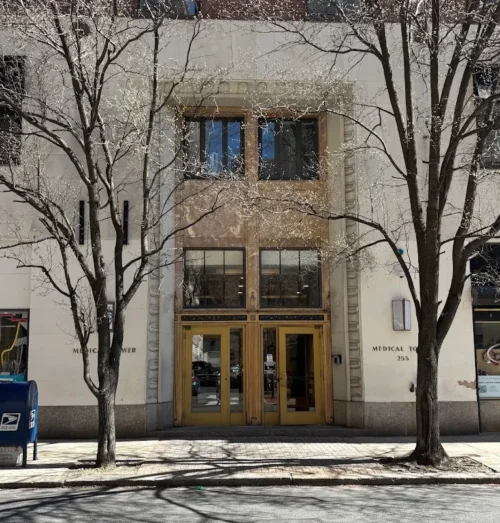
Philadelphia Therapy Office
In the heart of Center City Philadelphia, our office offers you convenient access to expert care. With flexible appointment times to accommodate your busy schedule, we’re committed to making your therapy journey as seamless as possible. Also offering online therapy in PA and NJ.